

Published on: 12/14/2025


Description
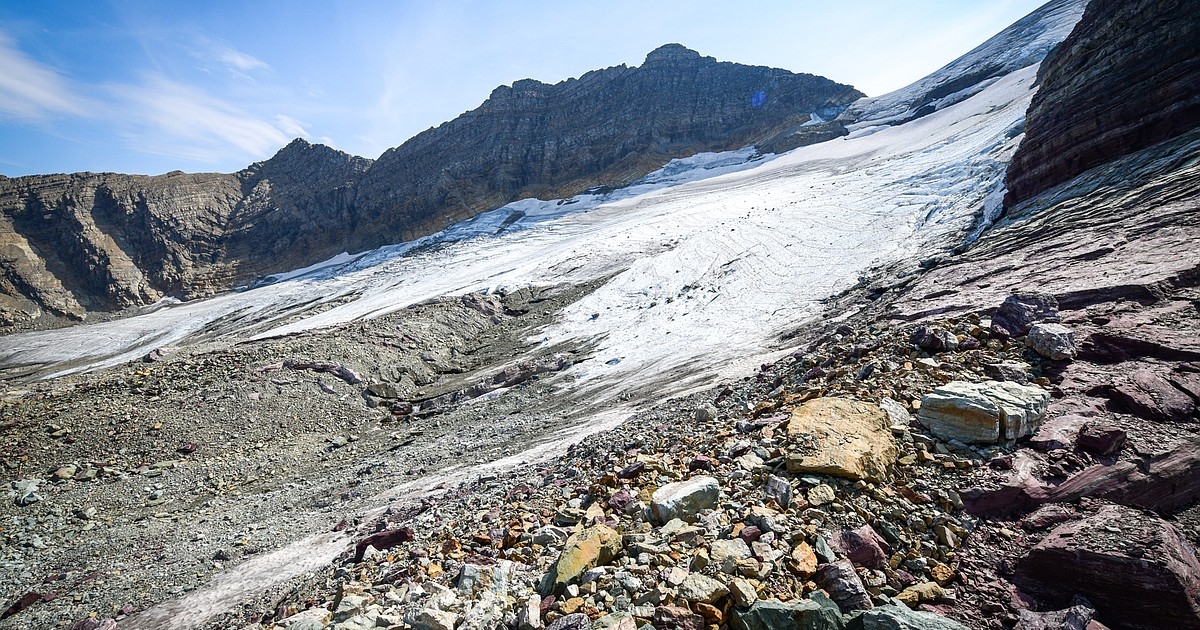
Northwest Montana’s glaciers are still melting, albeit slower than scientists previously predicted.
Models produced by climate scientists in the 2000s suggested that the masses of ice that gave Glacier National Park its name could disappear as early as 2030. Later predictions delayed the glaciers’ inevitable demise to 2050. Now, researchers say there is reason to believe some of the park’s perennial ice formations will persist into the 2100s.
“There’s still going to be ice on the landscape at the end of the century, but it’s going to look much different,” said Erich Peitzsch, a researcher with the United States Geological Survey who has spent upwards of a decade studying snow and ice in and around the Crown of the Continent.
He shared much of his knowledge and recently collected data at a public presentation co-hosted by the Flathead Lakers and Flathead Lake Biological Station.
“Sperry Glacier, which is small now — it’s about a kilometer squared, a little less — is going to be even smaller," said Peitzsch during the Dec. 4 talk. “Grinnell may be gone by then, but we’ll still see ice. It will probably resemble more of these permanent ice patches rather than actual glaciers.”
The United States Geological Survey defines a glacier as a perennial accumulation of ice and snow that slowly moves downslope. A glacier loses its designation once it either stops moving or does not retain snow year-round.
That has already happened to many of the glaciers in Northwest Montana. In the 1850s, between 80 and 144 glaciers dotted what is now considered Glacier National Park. By 2005, only 49 to 32 remained.
Spurred by the decline in glacial ice, researchers started using repeat photography and aerial imagery to monitor changes in the park’s glaciers in 2003.
A few years later, scientists began measuring snow density and mass on Sperry Glacier to better understand how climate change affected glacial hydrology. The project was integrated into the United States Geological Survey’s Benchmark Glacier Program in 2013. Other benchmark glaciers, which undergo similarly intensive studies each spring and summer, include South Cascade Glacier in Washington and Wolverine, Gulkana and Lemon Creek glaciers in Alaska.
Data from the benchmark glaciers quickly revealed that the ice forms were not only shrinking in area. They were also losing mass in a process Pietzsch likened to a leftover party balloon slowly losing air.
“The glaciers sort of act the same way,” said Peitzsch. “Now, they might not be losing as much area, but they’re deflating, so we’re still losing volume.”
When the glaciers began melting nearly two centuries ago, areas at low elevations that were exposed to sunlight were the first to go. Now that most glaciers are restricted to high-elevation areas with ample shade, the rate of area loss has slowed, but Pietzsch said many glaciers are still losing mass.
Those changes will be reflected in an upcoming inventory of Glacier National Park’s glaciers. The United States Geological Survey last released an inventory of the area of each of the park’s glaciers in April 2016, with plans to provide an update within the decade. Pietzsch said the production of the newest report has been delayed as researchers integrate new techniques for estimating glacial mass that use remote sensing technology.
“It’s a good problem to have because basically the data are so much better,” said Peitzsch.
He said the updated inventory of the park’s glaciers by area and mass would likely become available within the next year.
Size has posed another challenge for glaciologists. Historically, a glacier had to encompass at least 0.1 kilometers squared — the equivalent of about 25 acres — to be considered a glacier. As glaciers melt, Peitzsch said researchers are finding more formations that challenge those size constraints.
As of 2015, nine of the park’s 37 named glaciers were less than 0.1 kilometer squared. Some were already glaciers in name alone. Gem Glacier, for example, does not move and is technically considered a perennial ice field rather than a full-fledged glacier. But others matched the definition of a glacier, despite their small size.
“These glaciers are still glaciers. They’re behaving like glaciers. They’re moving, but they’re just really, really small,” said Peitzsch.
The United States Geological Survey now maintains an inventory for glaciers that meet the historical size requirements as well as an updated inventory that recognizes smaller glaciers.
IF THERE is a silver lining in the loss of snow and ice, it would be a reduction in what Peitzsch describes as large magnitude avalanche cycles.
Catastrophic avalanches have historically corresponded with periods of high snowpack. As warmer winter temperatures and changing precipitation patterns limit winter snowpack, Peitzsch reasoned that the chances of a large-scale avalanche would also decrease.
To determine whether his hunch was correct, he “went to the trees.” Over the course of several summers, Pietzsch examined more than 700 tree cookies for scars indicative of avalanche damage. He compared the resulting avalanche chronology to weather records to determine that large magnitude avalanche activity did, in fact, correspond with high-snowpack years.
But the study also suggested another connection between avalanches and late winter weather patterns. Around 1980, large avalanche cycles began to occur during low-snowpack years, Peitzsch said. He attributed the change to warmer spring temperatures that melted snowpack quickly, creating wet snow avalanches.
“When we have low snowpacks and if it’s cold enough still, we start to develop weak layers in the snowpack, so all it really takes is one big wet storm, for example, in the spring, and that can cause these big avalanche cycles as well,” said Peitzsch.
Wet avalanches blocked Going-to-the-Sun Road in May of both 2019 and 2021. While nobody was injured in the slides, several bikers were trapped on the road above Triple Arches until rescuers arrived.
Peitzsch said similar events could become more commonplace in the coming years. While he urged anyone recreating in or near snow and ice to exercise caution, Peitzsch was careful not to discourage winter recreation. Even in the midst of a changing climate, he said there was still plenty to enjoy this winter season.
“We’re still going to see snow. We’ll still have glaciers until the end of the century,” said Peitzsch. “They’ll just look very different, so hopefully we can all get out there and still appreciate what we have around.”
Reporter Hailey Smalley can be reached at 758-4433 or [email protected].
News Source : https://dailyinterlake.com/news/2025/dec/14/though-shrunken-and-deflated-glaciers-may-persist-through-end-of-century/
Other Related News
12/14/2025
Lincoln County officials during a public meeting Saturday afternoon in Libby addressed th...
12/14/2025
Marking its golden anniversary this year Keenans Jewelry has spent five decades serving c...
12/14/2025
To all those cynical adults who think dictionaries have gone the way of dinosaurs replace...

12/14/2025
A proposed subdivision on Trumble Creek Road will exacerbate long traffic delays on the r...
12/13/2025
Libby and Troy will host town hall meetings Saturday and Sunday about the recent flood da...
Follow


Download Our App


Copyright 2023 © Meet Montana. All Rights Reserved