

Published on: 12/07/2025


Description
For many who attended the Montana Land Board’s October 2025 meeting, the final vote to approve the Montana Great Outdoors Conservation Easement was a triumphant moment.
But for Matt Vincent, president of the Montana Mining Association, the occasion was far from celebratory.
“This is indeed an uncomfortable and unfortunate position I find myself in today,” Vincent told the Land Board during public comment on the proposal to seal 53,000 acres in Northwest Montana near the Thompson chain of lakes under a perpetual conservation easement.
The association supported much of what the easement provided, said Vincent, such as wildlife conservation, timber harvests and public recreational opportunities.
“And we’re also very pro-private property rights, which is where we find it necessary to stand in opposition to this conservation easement today,” he said.
His remarks echoed a years-long debate that has pitted the timber industry and public land advocates against mineral interests in Northwest Montana. A lawsuit filed by WRH Nevada alleged the federally funded state acquisition project clashed with its right to explore and extract minerals. The company owns the mineral rights to more than 53,000 acres of land converted into conservation easements by the state over the past five years.
Montana Fish, Wildlife and Parks secured development rights for the Lost Trails Conservation Easement in 2020. WRH Nevada owns the mineral rights to 95% of the 7,000-acre property, located a few miles northwest of Little Bitterroot Lake.
That purchase was quickly followed up with the state’s acquisition of the 27,000-acre Kootenai Forestlands Conservation Easement southeast of Libby, of which WRH Nevada owns mineral rights to about 3,560 acres.
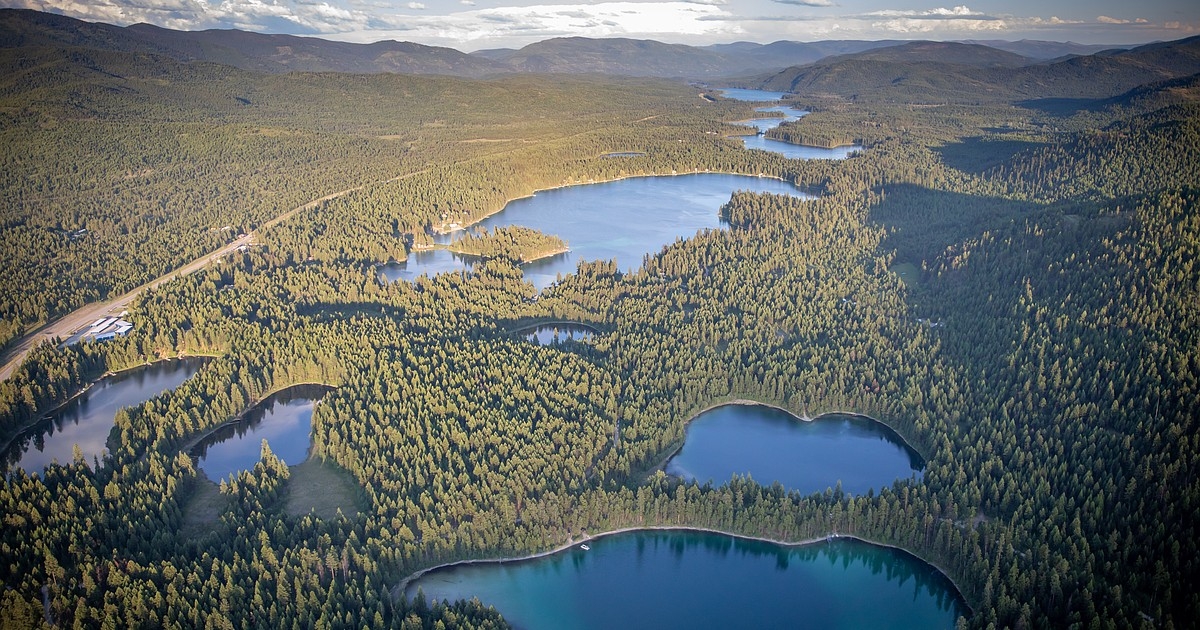
The most recent addition to the land conservation conglomerate is the Montana Great Outdoors Conservation Easement, a two-phase project that encompasses a total of 85,911 acres near the Thompson chain of lakes.
WRH’s lawsuit specifically challenges the authorization of Phase I of the project, which allowed Montana Fish, Wildlife and Parks to secure development rights for about 33,000 acres from Green Diamond Resource Company in early 2025. The agreement allows Green Diamond to continue timber extraction on the land but precludes the company and any future owners from intensive development projects, including large surface mines.
The purchase was largely facilitated by the Trust for Public Lands, a national nonprofit dedicated to creating and preserving public lands, as part of the organization’s signature “Forever Montana” campaign. Funds were contributed from the Forest Legacy Program, an initiative of the U.S. Forest Service to protect privately owned forestlands from being converted to non-forest uses.
WRH Nevada owns mineral rights to about 42% of the property included in Phase I, as well as 54% of the acreage slated for Phase II of the project.
The conservation easement received widespread support from the public and government officials, including Gov. Greg Gianforte. The first phase was finalized in February 2025, and the second and final phase of the project was approved by the Montana Land Board in October.
In its suit, WRH Nevada alleges that the state failed to follow the guidelines of the Forest Legacy Program, which contributed $20 million to the purchase. The federal program does allow for the purchase of conservation easements with split estates, so long as the purchaser secures “a determination by a qualified geologist” regarding the possibility of mineral development.
“The acquisition can proceed if the possibility of mineral development is so remote as to be negligible,” state the guidelines. “If severed mineral rights cannot be acquired, and those severed rights pose a threat to surface disturbance (that is, the “remoteness” standard cannot be met), that portion of the property is not eligible [for funding].”
The state contracted a mineral report for the proposed conservation easement in 2022, which found that there was a moderate probability for mineral occurrence but a low probability of developing those minerals, according to court documents.
“Based on this expert report, the likelihood of future development of commercially valuable mineral deposits on the subject property is remote,” stated a subsequent appraisal of the property, performed in 2023. “A significant investment of money and time would be required to prove the presence of economically recoverable minerals.”
WRH Nevada asserts it has made those investments. After acquiring the mineral rights to 825,000 acres in western Montana at a bankruptcy sale in 2016, WRH Nevada funneled upward of $7 million into investigating the property’s mineral development potential, according to court documents.
The company now claims those efforts revealed several potential deposits of porphyry, copper, silver, phosphate and vanadium which invalidate the state’s “remoteness” finding. It is unclear if any of those potential deposits underlay the conservation easement as the company enforces a strict non-disclosure policy on its data.
Montana courts have long held that mineral rights are dominant to surface rights, based on the conclusion that “in order to fully utilize a mineral estate, one usually must have access to the surface.”
Both Montana Fish, Wildlife and Parks and Green Diamond acknowledged this precedent in the final sale documents for the first phase of the Montana Great Outdoors Project, which stated that the newly established conservation easement does not “prevent such third parties use and occupancy of the surface of the land for exploration, recovery and development of the minerals consistent with their rights and Montana law.”
WRH Nevada nonetheless alleges that the conservation easement unfairly burdens its business, which relies largely on the sale and leasing of the mineral estate.
“Prospective business partners actively engaged in transactional discussions with WRH pursuant to multiple non-disclosure agreements had backed away from further discussions because of the Montana Great Outdoors conservation project,” state the plaintiffs in their findings of fact.
The lawsuit goes on to claim that the environmental review Montana Fish, Wildlife and Parks conducted in relation to the conservation easement failed to appropriately account for impacts the project would have to the region’s mining industry and culture.
“There is no mention of social demand for critical minerals or any meaningful discussion of mineral potential ... The proposed [easement] conflicts directly with presidential directives to increase domestic exploration and development of critical minerals,” court documents state.
Since WRH initially filed the lawsuit in August 2024, the second Trump administration has made further efforts to expand domestic mining production.
An executive order filed in March directed additional financial resources to the identification and extraction of critical minerals, copper, gold, potash and uranium and ordered several departments to overhaul the permitting system to make it easier for new mines to obtain licenses.
One of the initiatives to benefit from the recently expedited process was Hecla Mining Company’s Libby Exploration Project, which aims to explore possible copper and silver deposits under the Cabinet Mountains. Despite ample criticism from environmental groups, the project was greenlit by the Forest Service in October.
Formerly known as the Montanore Mine, the main site for the Libby Exploration Project is less than a dozen miles from the border of the Montana Great Outdoors Conservation Easement.
About 319 acres within the easement have already been opened for mineral entry, according to the American Exploration and Mining Association. The 130-year-old national association of miners with an international membership said the conservation easement clashes with federal mineral interests, as well as private, in an Oct. 19 letter to the Montana Land Board.
The federal government owns mineral rights to 2,900 acres of the easement. The geological formations under the easement contain minerals labeled as critical by the Trump administration, a detail that was excluded from the state’s project planning documents, the letter stated.
The association echoed concerns of WRH Nevada regarding the effect of the easement on privately held mineral rights, as the state must approve all mining permits. That process occurs through the Department of Environmental Quality, which operates separately from Montana Fish, Wildlife and Parks. The association argued that the state agency would still be deterred from approving mining permits “that conflict with the purposes set forth in the state’s conservation easement.”
The Montana Mining Association voiced similar concerns in its own letter to the Land Board.
“If a court were to uphold the rights of the severed mineral interest owners, any conservation easement where severed minerals exist in the state will be subject to lawsuit ... On the other hand, a lawsuit resulting in a restriction on mineral rights and their dominance will immediately, and perhaps irreversibly, chill future mineral development within the state,” wrote Vincent in a letter to the Montana Land Board.
Judge Matthew Cuffe is currently assigned to review the case in Lincoln County District Court. Plaintiffs filed a motion in October to remove Cuffe from the case, citing public support for the easement by his father, Sen. Mike Cuffe, R-Eureka, as a conflict of interest. The defendants have filed a motion to dispute the recusal.
Reporter Hailey Smalley can be reached at 758-4433 or [email protected]. Reporter Hannah Shields can be reached at 758-4439 or [email protected].
News Source : https://dailyinterlake.com/news/2025/dec/07/massive-land-conservation-project-brings-property-right-tensions-to-the-surface/
Other Related News

12/07/2025
Scenes from the Kalispell Downtown Association Holiday Stroll and Community Tree Lighting...

12/07/2025
Led by longtime Flathead High School band director Allen Slater the Flathead Valley Commu...

12/07/2025
Sanders County officials said last week that law enforcement is investigating a former Ho...

12/06/2025
Nearly 60 primary care physicians nurse practitioners and physician assistants working at...

12/05/2025
HELENA Mont The Helena Police Department has issued a community alert following a series ...
Follow


Download Our App


Copyright 2023 © Meet Montana. All Rights Reserved